Removed Without Record: Charting the Constitutional Blind Spots in America's Expedited Deportation System
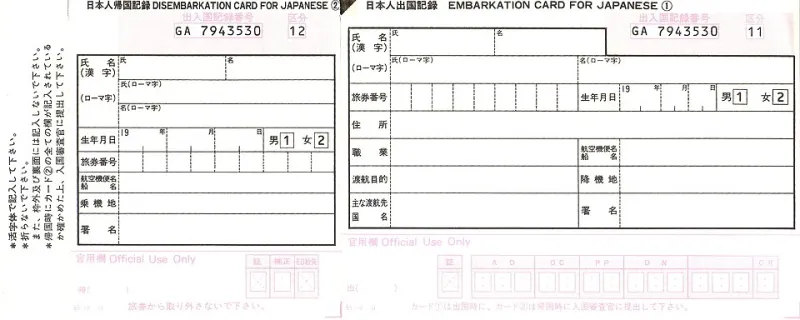
Photo: 日本国法務省入国管理局 (Immigration Bureau, Ministry of Justice of Japan); scanned by Yasu (talk), Public domain, via Wikimedia Commons
In the American legal imagination, deportation is a formal proceeding. An individual receives notice. An immigration judge weighs the evidence. An attorney, if one can be obtained, argues on the client's behalf. An appeal is possible. Due process, however imperfectly realized, is at least structurally present.
For a substantial and growing portion of the people removed from the United States each year, this picture is fiction. They are processed through administrative channels that bypass immigration courts entirely, removed within hours or days of apprehension, and entered into statistical systems that obscure rather than illuminate what happened to them. The mechanism enabling this is expedited removal, and its expansion over the past two decades represents one of the least scrutinized shifts in American immigration enforcement.
Understanding its true scope requires assembling data from sources that were not designed to be assembled — and confronting the probability that the full picture remains, by design, out of reach.
What Expedited Removal Is, and What It Has Become
Expedited removal was codified in the Illegal Immigration Reform and Immigrant Responsibility Act of 1996. In its original form, it authorized immigration officers to remove, without a hearing, individuals apprehended at ports of entry who lacked valid documentation. Its geographic and temporal scope was deliberately circumscribed: it applied at the border and to recent arrivals.
Over the subsequent decades, through a combination of statutory amendment and executive expansion, expedited removal's reach has grown substantially. By the late 2010s, it had been extended to individuals apprehended anywhere in the United States who could not demonstrate continuous physical presence for more than two years. The Trump administration moved to apply it nationwide and without the two-year limitation, a policy that faced legal challenges but signaled the direction of executive appetite. The Biden administration, despite rhetoric emphasizing due process, continued using expedited removal at significant scale along the southern border.
The result is a system in which a meaningful share of all deportations — the exact proportion is itself a data problem, discussed below — occur through a process that provides no immigration court hearing, no automatic right to counsel, and limited opportunity to present claims for asylum or other forms of protection.
The Data Problem: What We Know and Why We Don't Know More
The primary official source for deportation data is Immigration and Customs Enforcement's annual report, supplemented by statistics from Customs and Border Protection. These reports provide aggregate removal numbers, broad nationality breakdowns, and some information about criminal history. They do not consistently distinguish between cases processed through immigration courts and those processed through expedited removal. They do not provide information about whether individuals subjected to expedited removal raised asylum claims, whether those claims were assessed by a trained asylum officer, or whether the individual was returned to a country where they may face persecution.
The Government Accountability Office has periodically examined expedited removal practices and found significant documentation deficiencies. A 2020 GAO report identified inconsistencies in how CBP officers record the basis for expedited removal orders and noted that the agency lacked reliable mechanisms to track whether required credible fear screenings were being conducted. The DHS Office of Inspector General has issued similar findings across multiple administrations.
Freedom of Information Act litigation has produced fragments of a more complete picture. The American Immigration Council, the ACLU, and several academic research centers have used FOIA requests to obtain records that reveal patterns invisible in official statistics — including cases in which individuals with colorable asylum claims were removed without any screening, cases in which US citizens or lawful permanent residents were mistakenly subjected to expedited procedures, and cases in which translation failures resulted in individuals waiving rights they did not understand they possessed.
These FOIA-derived datasets are invaluable, but they are also incomplete, inconsistently formatted, and frequently redacted in ways that limit their analytical utility. They represent what determined advocates have been able to extract, not a systematic accounting of what exists.
Populations Most Exposed to Accelerated Removal
The populations most frequently subjected to expedited removal share characteristics that compound their vulnerability. They are disproportionately unrepresented by counsel — a condition that correlates strongly with expedited processing, since individuals with attorneys are more likely to have their cases routed to immigration court. They are disproportionately from Central American and Caribbean countries, reflecting patterns of border enforcement concentration. They include substantial numbers of individuals who report fleeing gang violence, domestic abuse, or political persecution — precisely the categories of claim that require individualized adjudication and that expedited removal is structurally ill-suited to evaluate.
Family separation cases documented during and after the 2018 zero-tolerance policy provide a particularly stark illustration of what happens when expedited removal intersects with asylum-seeking populations. Court records and advocacy group reports from that period identified numerous instances in which parents were processed for expedited removal while their children entered a separate administrative track, with no mechanism to ensure the family's reunification or to preserve the parent's asylum claim in a form that could be reasserted.
Unaccompanied minors occupy a nominally protected category under the Trafficking Victims Protection Reauthorization Act, which requires that children from non-contiguous countries receive a referral to HHS rather than immediate removal. Monitoring by the Women's Refugee Commission and other organizations has found that this protection is inconsistently applied, and that the data systems used to track compliance are fragmented across CBP, ICE, and HHS in ways that make independent verification difficult.
Building a Transparency Infrastructure for Removal Proceedings
For researchers, advocates, and policymakers seeking to assess the constitutional adequacy of expedited removal, the following resources represent the most useful currently available tools — and a map of where the gaps are most severe.
The Syracuse University TRAC Immigration database aggregates immigration court data and provides some of the most granular publicly available information on removal proceedings, though its coverage of expedited cases is limited by the fact that those cases never enter the court system it tracks. The National Immigration Law Center and the American Immigration Lawyers Association maintain practitioner-facing resources that document procedural irregularities in expedited cases. The Center for Migration Studies publishes demographic analyses that can be cross-referenced against official removal statistics to identify population-level discrepancies.
FOIA request templates developed by the Reporters Committee for Freedom of the Press and by immigration law clinics at several US law schools provide structured pathways for obtaining CBP and ICE records. The ACLU's ongoing litigation docket, publicly accessible through its website, identifies active cases challenging expedited removal practices and often surfaces evidentiary records that would not otherwise be available.
What does not yet exist — and what would represent a transformative advance in accountability — is a centralized, publicly accessible database that records, at minimum, the number of expedited removals conducted each month, the nationalities involved, the rate at which credible fear screenings were triggered and their outcomes, and the rate at which expedited orders were later challenged and overturned. Several advocacy organizations have proposed such a system, and legislation to require it has been introduced in Congress without advancing to a vote.
Silence as Administrative Strategy
The absence of comprehensive data on expedited removal is not simply an oversight. Administrative systems reflect priorities, and a system that generates limited, aggregate, difficult-to-disaggregate data on a practice that removes people without hearings is a system that has chosen opacity. That choice has constitutional implications: judicial review of expedited removal is severely limited, and the evidentiary record available to courts reviewing the rare challenges that do proceed is shaped by the same documentation gaps that prevent independent oversight.
For human rights researchers and advocates, the imperative is twofold: to use every available tool to extract and synthesize the data that does exist, and to make the case — loudly and persistently — that the creation of a genuine transparency infrastructure for expedited removal is not a bureaucratic nicety but a constitutional necessity. The people removed without record deserve, at minimum, to be counted.