Scattered Records, Uncertain Lives: The Case for a Unified Refugee Data System in America
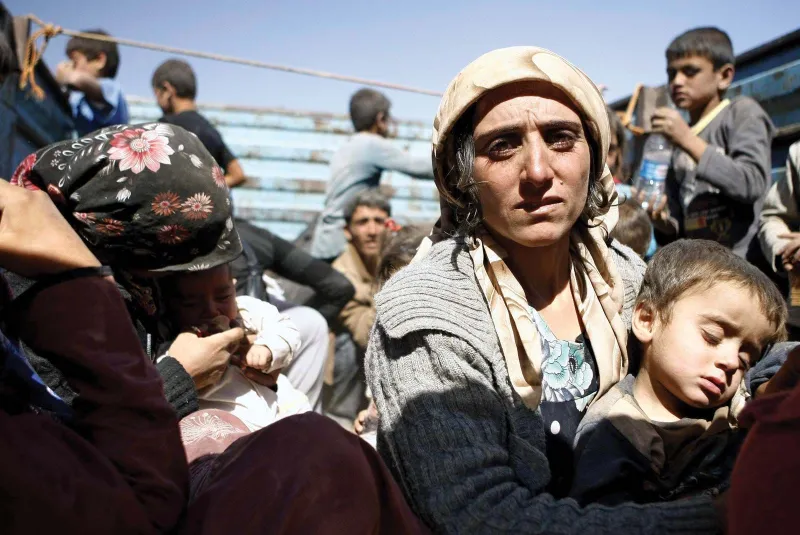
Photo: refugee family paperwork government office resettlement, via cdn.britannica.com
Every year, thousands of refugees are admitted to the United States under one of the world's most scrutinized resettlement programs. They arrive after years of vetting, displacement, and often profound loss. And then, in a very specific bureaucratic sense, many of them disappear.
Not literally—but from the perspective of coherent federal data collection, their stories splinter almost immediately. A refugee family resettled in Columbus, Ohio, might appear in State Department admissions records, in a local resettlement agency's case management system, in a county public health database, and perhaps in a separate UNHCR statistical report—none of which speak to one another in any meaningful way. The result is a fragmented data ecosystem that obscures whether the program is actually working, for whom, and at what human cost.
A System Built on Silos
The US Refugee Admissions Program (USRAP) is administered primarily through the State Department's Bureau of Population, Refugees, and Migration (PRM), which coordinates with the Department of Homeland Security, the Department of Health and Human Services' Office of Refugee Resettlement (ORR), and a network of nine federally funded voluntary agencies—known as volags—that manage on-the-ground resettlement. Each of these entities collects data. None of them collect the same data, in the same format, on the same timeline.
PRM tracks admissions figures and country-of-origin demographics. ORR monitors early resettlement services—cash assistance, employment support, English-language instruction—but its data collection typically ends 90 days after arrival for most service categories, precisely the moment when many of the most critical integration challenges begin to emerge. The volags maintain their own proprietary case management systems, most of which are not subject to public disclosure requirements. UNHCR publishes global statistics that frequently diverge from domestic figures due to differing definitions and counting methodologies.
The gaps between these systems are not incidental. They are structural, and they have consequences.
What the Missing Data Conceals
Consider the issue of family separation—a subject that has generated enormous political attention in the context of asylum seekers at the southern border, but which remains chronically underreported within the formal resettlement pipeline. Refugees are often admitted in fragmented family units due to processing delays, security holds on individual family members, or bureaucratic misclassifications. There is no centralized federal mechanism to track how many refugee families arrive incomplete, how long separations persist, or whether reunification ever occurs.
Similarly, long-term economic and social integration outcomes are effectively invisible in the federal data record. Studies conducted by academic researchers and advocacy organizations—including work by the International Rescue Committee and the National Immigration Forum—have consistently found that refugees, when given adequate support, achieve economic self-sufficiency at rates comparable to or exceeding other immigrant populations over a ten-year horizon. But this evidence has been assembled through independent research efforts, not because the federal government is systematically tracking it. When the Trump administration used contested economic analyses to justify dramatic reductions in refugee admissions ceilings, advocates lacked a robust, government-maintained dataset to mount a comprehensive empirical counterargument.
Health outcomes present a similar blind spot. Refugees frequently arrive carrying the physical and psychological burdens of prolonged displacement—trauma, untreated chronic conditions, nutritional deficiencies. The degree to which the resettlement system addresses these needs, or fails to, is largely invisible in aggregate federal data. Some states with large refugee populations, such as Minnesota and Texas, maintain more detailed health tracking systems. Most do not.
The Political Economy of Data Fragmentation
It would be a mistake to treat this fragmentation as purely a technical or administrative problem. Data architecture reflects political priorities. The agencies responsible for refugee resettlement have historically operated under significant resource constraints and, during certain administrations, under active political pressure to minimize the program's visibility and scale. Comprehensive outcome tracking costs money and creates accountability—two things that have not always been welcomed by program administrators or their political overseers.
Federal contracting structures compound the problem. The volags receive per-capita resettlement funding tied to specific service windows, not to long-term outcomes. They have limited financial incentive to build longitudinal data systems, and limited legal obligation to share whatever data they do collect with federal agencies or the public. This arrangement insulates contractors from accountability while simultaneously depriving policymakers of the information they would need to evaluate contractor performance.
What Unified Standards Would Make Possible
Advocates and researchers have been calling for standardized federal refugee data infrastructure for more than a decade. The framework they envision is not technically complex—it would require a common set of data fields collected at consistent intervals across all federally funded resettlement programs, a centralized (but appropriately privacy-protected) longitudinal database, and mandatory public reporting requirements tied to meaningful outcome metrics.
Such a system would enable, for the first time, genuine evidence-based policy. Legislators debating admissions ceilings would have access to comprehensive outcome data rather than anecdotal evidence or advocacy-funded studies. Researchers could identify which resettlement models—geographic placement decisions, service package designs, community sponsorship arrangements—produce the best long-term outcomes for which refugee populations. Family separation within the pipeline could be tracked, reported, and addressed as a systemic issue rather than an invisible one.
Perhaps most importantly, refugees themselves would benefit from a system that treated their experiences as data worth collecting—not as administrative inconveniences to be processed and forgotten after the 90-day service window closes.
The Advocacy Path Forward
Several legislative proposals have attempted to address pieces of this problem. The Refugee Resettlement Accountability and Transparency Act, introduced in various forms over recent congressional sessions, would impose new reporting requirements on federal resettlement contractors. The Global Fragility Act created some new frameworks for tracking outcomes in conflict-affected regions. Neither has produced the kind of comprehensive domestic data reform the situation demands.
For advocates, the immediate priority is visibility. Filing Freedom of Information Act requests for the data that does exist—ORR case outcome reports, PRM admissions records, HHS refugee health screening data—can help map the current landscape and identify the most critical gaps. Coordinating with academic partners to conduct independent longitudinal studies creates an evidentiary record that can support legislative advocacy. And building public pressure for data transparency, framed not as a bureaucratic concern but as a human rights issue, is essential to making unified federal standards politically viable.
The refugees who come to the United States carry with them histories of extraordinary resilience. They deserve a government capable of seeing them clearly—not just at the moment of arrival, but across the arc of their lives in this country. Right now, the data systems that are supposed to track their progress are not up to that task. Fixing them is not a technical nicety. It is a prerequisite for honest, humane policy.