Conditional in Name Only: How US Foreign Aid Waivers Hollow Out Human Rights Accountability
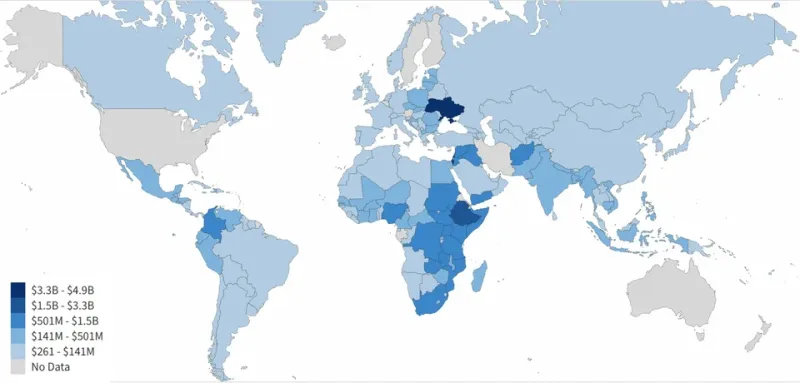
Photo: foreignassistance.gov, Public domain, via Wikimedia Commons
Every year, the United States government distributes tens of billions of dollars in foreign assistance to governments whose human rights records range from imperfect to openly repressive. Embedded within the legislation authorizing much of that aid are conditions — statutory requirements that recipient governments meet specific benchmarks before funds are released. On paper, these conditions represent one of Washington's most direct mechanisms for incentivizing reform. In practice, a durable system of waivers, certifications, and bureaucratic discretion ensures that the money flows almost regardless of what happens to the activists, journalists, and civil society organizations living under those governments.
This is not incidental. It is structural.
The Architecture of Conditionality
US foreign aid conditionality operates through several distinct legal channels. The Leahy Law — named after former Senator Patrick Leahy of Vermont — prohibits the State Department and Pentagon from providing assistance to foreign security units credibly implicated in gross human rights violations. Separate provisions in annual appropriations legislation frequently attach country-specific conditions, requiring the Secretary of State to certify that a recipient government is, for instance, cooperating with investigations into past atrocities or protecting the rights of journalists.
But the same legislation that creates these conditions almost invariably includes a national security waiver — a clause allowing the executive branch to override the requirement if it determines that doing so serves American strategic interests. The threshold for invoking such waivers is deliberately low, and the process for doing so is largely insulated from public scrutiny. When a waiver is exercised, the administrative record justifying that decision is rarely disclosed in full. What reaches the public, if anything, is a terse certification letter — a document that confirms a decision was made without explaining the deliberation behind it.
The data gap this creates is profound. Researchers attempting to correlate aid flows with human rights conditions on the ground frequently discover that the documentary trail ends precisely where the most consequential decisions were made.
Case Patterns: Where the Conditions Disappeared
The pattern repeats across regions and administrations. In Egypt, US military assistance — which has historically exceeded $1.3 billion annually — has continued through successive crackdowns on civil society, including the passage of laws that effectively criminalized independent NGO activity and the imprisonment of journalists under broad counterterrorism statutes. The conditions attached to portions of that aid have been waived repeatedly, with successive administrations citing regional stability and counterterrorism cooperation as justification.
In Honduras, aid packages conditioned on judicial reform and anti-corruption measures continued flowing during periods when credible documentation from Human Rights Watch, Amnesty International, and local monitoring groups recorded escalating violence against land rights defenders and LGBTQ+ activists. Certification decisions — which require the State Department to affirmatively conclude that conditions are being met — were issued despite publicly available evidence suggesting otherwise.
In the Philippines during the Duterte administration, the United States maintained substantial security assistance even as the International Criminal Court opened a preliminary examination into extrajudicial killings linked to the government's drug war. Congressional pressure eventually led to a partial suspension of some equipment transfers, but the episode illustrated how long the bureaucratic system could sustain business as usual in the face of documented violations.
None of these cases represent a simple story of American complicity. Geopolitical relationships are genuinely complex, and the leverage that aid conditionality provides is real — but only if conditions are enforced. The recurring problem is that enforcement is discretionary, and the discretion is exercised within a bureaucratic culture that consistently weights strategic interests above human rights benchmarks.
What the Data Does — and Doesn't — Show
For researchers and advocates attempting to quantify the relationship between aid conditionality and civil society conditions on the ground, the evidentiary landscape is deeply uneven. The State Department publishes annual Country Reports on Human Rights Practices — a substantial resource that documents violations with considerable specificity. USAID maintains databases of assistance flows that allow analysts to track funding levels over time. Congressional Research Service reports periodically synthesize the legislative history of specific conditionality provisions.
What these sources cannot easily provide is a synchronized record linking specific waiver decisions to specific documented violations — a dataset that would allow analysts to ask, with empirical precision, whether conditions were waived in the same periods that credible reports documented deteriorating civil society space. Constructing such a record requires cross-referencing State Department certification letters (obtained through FOIA requests), appropriations legislative history, USAID disbursement data, and independent human rights monitoring reports — a labor-intensive process that most civil society organizations lack the capacity to undertake systematically.
This is not an accident of bureaucratic disorganization. It reflects the fact that no single agency is required to maintain a unified, publicly accessible record of waiver decisions alongside the human rights documentation that was available at the time those decisions were made.
The Civil Society Cost
The consequences of this accountability gap are not abstract. When aid continues flowing to a government despite documented crackdowns, it sends a legible signal to that government's security services: the costs of repression are manageable. Local activists and journalists read that signal too. Organizations that might otherwise seek to document abuses and present them to international partners — including American officials — face the rational calculation that the documentation will not change the outcome.
In interviews conducted by human rights organizations with civil society actors in aid-recipient countries, a recurring theme is the corrosive effect of perceived impunity on local organizing. When a government understands that US assistance is effectively unconditional in practice regardless of what the legislation says, the deterrent value of those conditions collapses. The people who bear the cost of that collapse are not in Washington.
Building a More Legible Record
Addressing this accountability gap requires action at multiple levels. Congress can strengthen conditionality provisions by narrowing waiver authority, requiring detailed public justifications when waivers are invoked, and mandating that the State Department maintain a unified, searchable record of certification decisions alongside the human rights documentation available at the time of each decision. Advocates can use existing FOIA tools more aggressively to reconstruct the administrative record of past waiver decisions — and publish those reconstructions in formats accessible to both researchers and affected communities abroad.
At minimum, the American public deserves to know, in legible and specific terms, when their government has chosen to prioritize a strategic relationship over the safety of journalists, activists, and civil society workers in a recipient country. That is not an anti-aid argument. It is an argument for honest accounting — for a payoff ledger that reflects what conditionality actually costs when it is abandoned, and who pays that cost.
The data to build that ledger exists, scattered across agency databases, congressional archives, and civil society monitoring reports. The missing element is not information. It is the institutional will to assemble it honestly and make it public.